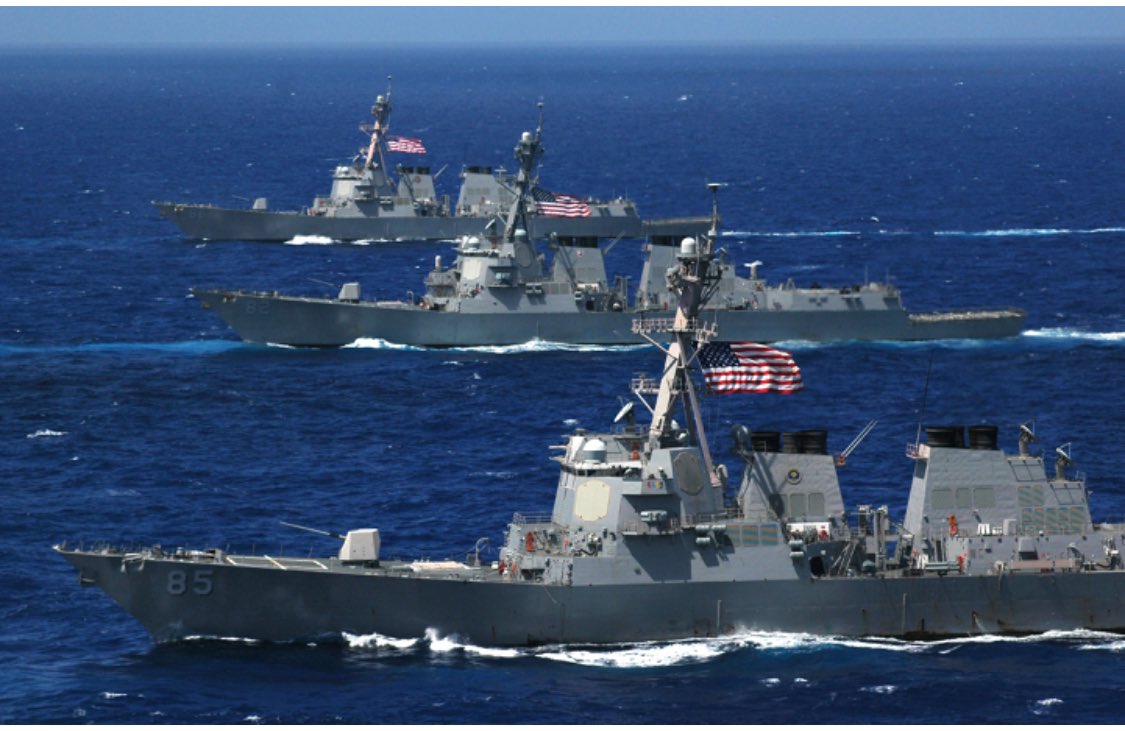
United States President Donald Trump has said that a powerful U.S. naval force is heading toward Iran, warning Tehran against renewed nuclear activity or further violence against protesters, even as he expressed hope that military action would not be necessary.
Speaking to reporters aboard Air Force One on Thursday, Trump said the United States was closely monitoring Iran and had positioned multiple warships in the region as a precaution.
“We have a lot of ships going that direction, just in case. I’d rather not see anything happen, but we’re watching them very closely,” Trump said, adding later: “We have an armada heading in that direction, and maybe we won’t have to use it.”
U.S. officials, speaking on condition of anonymity, confirmed that the aircraft carrier USS Abraham Lincoln and several guided-missile destroyers are expected to arrive in the Middle East in the coming days after redeploying from the Asia-Pacific region.
According to one official, the Pentagon is also considering deploying additional air-defense systems to protect U.S. military bases in the region in the event of a potential Iranian strike.
The latest deployments expand Washington’s military options at a time of heightened tensions with Tehran, following U.S. airstrikes on Iranian nuclear facilities in June and a renewed crackdown on protests inside Iran.
Trump reiterated that the United States would respond forcefully if Iran attempts to restart its nuclear program.
“If they try to do it again, they have to go to another area. We’ll hit them there too, just as easily,” he said.
He also claimed that Iran had halted mass executions following U.S. threats, alleging that nearly 840 planned hangings were canceled.
“At an hour before this horrible thing was going to take place, they canceled it,” Trump said, calling the move “a good sign.”
Iran has not publicly confirmed the claim.
Iran is required to report to the International Atomic Energy Agency (IAEA) on the status of nuclear sites struck by the United States and on the whereabouts of its nuclear material, including an estimated 440.9 kilograms of uranium enriched to 60% purity.
According to IAEA benchmarks, such material could be sufficient to produce up to 10 nuclear weapons if further enriched.
The nuclear watchdog has not verified Iran’s stockpile of highly enriched uranium for at least seven months, despite recommending monthly inspections.
Protests in Iran, which began on December 28 over economic hardship in Tehran’s Grand Bazaar, rapidly spread nationwide before appearing to taper off in recent weeks.
The U.S.-based human rights group HRANA said it has verified 4,519 deaths linked to the unrest, including 4,251 protesters, with more than 9,000 additional deaths still under review.
An Iranian official told Reuters that confirmed deaths exceeded 5,000, including about 500 security personnel.
When asked about the number of protesters killed, Trump said:
“Nobody knows… it’s a lot, no matter what.”
While U.S. military buildups in the Middle East have historically been framed as defensive, last year’s surge preceded direct strikes on Iran’s nuclear infrastructure.
The current deployment has raised concerns about the risk of further escalation in an already volatile region.
U.S. officials say the situation remains fluid, with Washington balancing military readiness against diplomatic efforts to prevent a broader conflict.