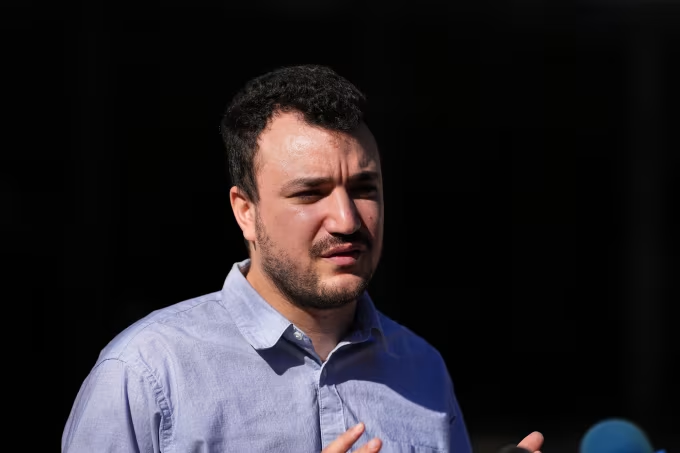
A US federal appeals court has reversed a lower court ruling that led to the release of Palestinian activist Mahmoud Khalil from immigration detention, paving the way for the government to again pursue his detention and possible deportation.
In a 2–1 decision delivered on Thursday, a three-judge panel of the 3rd US Circuit Court of Appeals in Philadelphia ruled that the New Jersey federal district court lacked jurisdiction to hear Khalil’s habeas petition, which had secured his release from immigration custody.
The panel held that under federal immigration law, challenges to detention and removal must be pursued through a petition for review of a final deportation order at the appellate court level, rather than through a district court.
As a result, the judges instructed the lower court to dismiss Khalil’s petition.
In its ruling, the court noted that the legal framework limits immigrants to a single avenue for judicial review, meaning some individuals may be required to wait longer before seeking relief from alleged unlawful government actions.

Khalil’s legal team criticised the decision. His lawyer, Baher Azmy, said the ruling was disappointing but vowed to continue challenging what he described as Khalil’s unlawful detention through other legal channels.
The decision represents a significant boost for the administration’s broader effort to detain and deport noncitizens involved in protests against Israel.
Khalil, a prominent pro-Palestinian activist at Columbia University, was arrested at his apartment in March 2025 and spent about three months in an immigration detention facility in Louisiana. His detention caused him to miss the birth of his first child.
Federal authorities have accused Khalil of engaging in activities aligned with Hamas, though no criminal charges have been filed and no evidence has been publicly presented to support the claim.
The government has relied on a rarely used immigration statute that allows for the removal of noncitizens whose actions or beliefs are deemed harmful to US foreign policy interests.
In June, a federal judge ordered Khalil’s release, ruling that the government’s justification was likely unconstitutional.
That decision was appealed by the administration, which argued that immigration judges, not federal courts, should determine deportation matters.
Officials have also alleged Khalil failed to disclose information on his green card application, claims he has dismissed as baseless.
The appeals court ruling comes as an immigration appeals board considers an earlier decision by an immigration judge who found Khalil eligible for deportation.
Authorities have suggested he could be removed to Algeria or Syria, a prospect his lawyers argue would place his life in serious danger.
Legal proceedings in the case are ongoing.