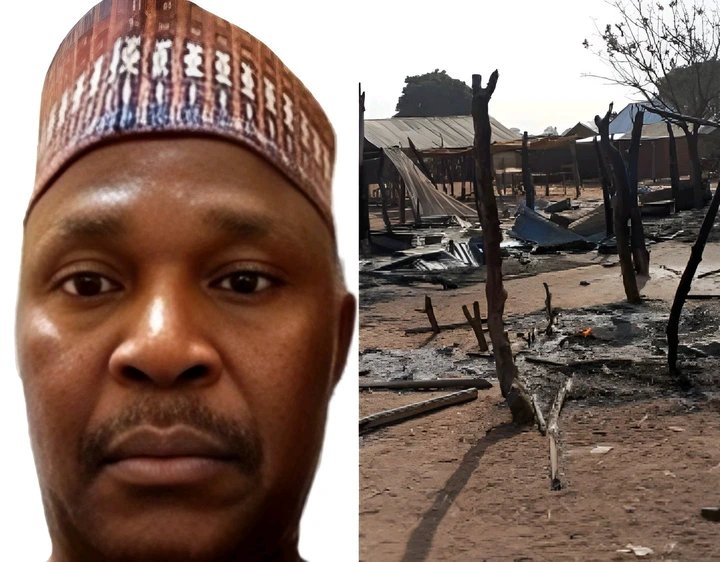
Former Brigade Commander of Operation Lafiya Dole in the North-East, Yahaya Lakale, has revealed disturbing details about the recent terrorist attack at Kasuwan Daji Market in Niger State.
DDM gathered that Lakale disclosed there were no active security personnel present at the market when the deadly attack occurred.
Speaking during an interview on Channels Television, the retired senior military officer described the incident as a tragic consequence of prolonged security neglect.
Lakale confirmed that by 10:00 a.m. on Sunday, at least 55 bodies had already been recovered from the scene of the massacre.

He said the death toll was established through a direct physical count carried out in the aftermath of the attack.
According to him, he personally instructed local authorities and community leaders not to bury any victim until proper documentation was completed.
Lakale explained that his directive was aimed at ensuring transparency and accuracy in reporting the scale of the tragedy.
He stated that the bodies were to be counted, recorded on video, photographed, and properly documented before burial.
The former brigade commander lamented that conflicting reports had emerged about the incident, creating confusion and misinformation.
He insisted, however, that the figure of 55 corpses counted by mid-morning was accurate and verifiable.
Lakale described Kasuwan Daji as a well-known hotspot for terrorist and bandit activity.
Despite this reputation, he said the area has suffered from little to no meaningful security deployment for several years.
He expressed concern that communities repeatedly targeted by armed groups are often left without adequate protection.
Lakale noted that the absence of security forces created an enabling environment for terrorists to operate freely.
He warned that ignoring such vulnerable locations only emboldens criminal groups and increases civilian casualties.
The retired officer further highlighted the geographical proximity between Kasuwan Daji Market and Papiri village.
Papiri village was previously in the news following the abduction of schoolchildren by suspected bandits.
Lakale said both locations are separated by only a short distance, roughly a 20-minute drive.
Despite their closeness, he explained that the areas fall under different administrative jurisdictions.
Kasuwan Daji Market is located in Borgu Local Government Area of Niger State.
Lakale argued that such administrative boundaries should not be an excuse for gaps in security coverage.
He emphasized that terrorists do not respect local government boundaries when planning attacks.
The former commander criticized what he described as a pattern of reactive security responses rather than preventive deployment.
He said communities often receive attention only after mass casualties have already occurred.
Lakale called for proactive intelligence-driven security presence in known flashpoints across Niger State.
He stressed that markets, schools, and rural communities remain prime targets for armed groups.
According to him, the failure to protect such spaces undermines public confidence in state protection.
Lakale also pointed out that repeated attacks have traumatized residents and disrupted economic activities.
Kasuwan Daji Market, he said, serves as a vital trading hub for surrounding communities.
The attack has reportedly forced many residents to flee the area out of fear of further violence.
Security analysts say Lakale’s revelations raise serious questions about operational readiness and deployment strategy.
Civil society groups have called for an independent investigation into the security lapses surrounding the attack.
Residents are also demanding accountability from both state and federal authorities.
They argue that known terror hotspots should never be left without visible security presence.
The Niger State attack adds to growing concerns about insecurity spreading beyond Nigeria’s traditional conflict zones.
Observers warn that without urgent action, similar tragedies could occur in other neglected rural communities.
Lakale concluded by urging authorities to prioritize human lives over bureaucratic procedures and political calculations.
He stressed that preventing future massacres requires sustained security commitment, not temporary responses after public outrage.
The tragedy at Kasuwan Daji Market stands as another painful reminder of the cost of delayed and inadequate security intervention in Nigeria.